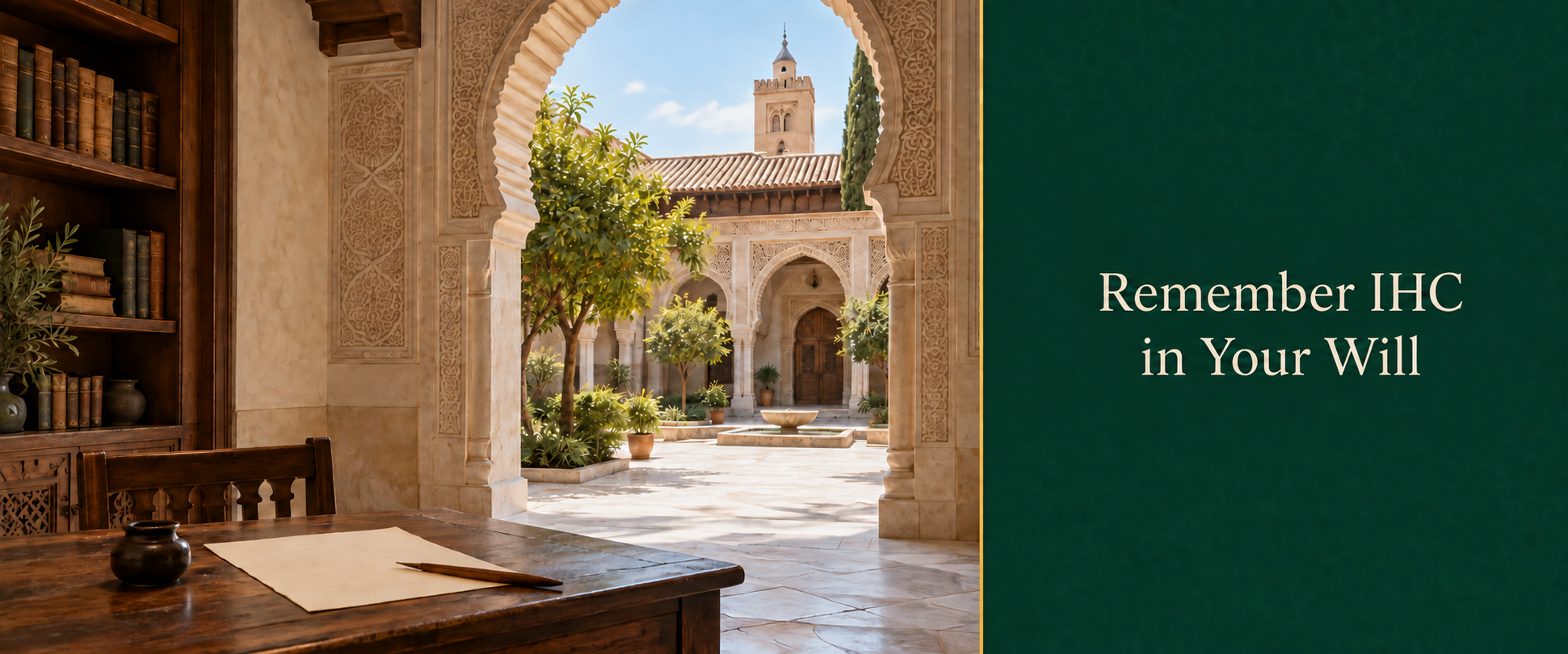
Support Quran Learning, Beneficial Knowledge, and Community CareRemember IHC in Your Will
Leave something in your will that can continue to benefit others: Quran lessons for a student, knowledge that guides a Muslim in worship and daily life, and help for a family in need. A charitable bequest is an opportunity to use part of your wealth for people's benefit, seeking Allah's pleasure and hoping for continuing reward, by His permission.
By leaving a specified amount or percentage to Islamic Heritage Center (IHC), you help sustain Quran education, beneficial knowledge, and community service. Remember IHC as you prepare your will, caring for your loved ones while sharing in good that can reach those who come after you.
Allah says: "Any good you put forward for yourselves, you will find with Allah, better and greater in reward." Surah al-Muzzammil, excerpt from 73:20; translation of the meaning.
The Messenger of Allah, peace and blessings be upon him, said: "When a person dies, their deeds come to an end except for three: an ongoing charity, knowledge from which people benefit, or a righteous child who prays for them." Sahih Muslim, 1631; translation of the meaning.
Why Remember IHC in Your Will?
IHC brings Islamic learning and community service together. It is a place where Muslims learn the Quran and their religion, where young people and adults attend lessons that help them understand and practice their faith, and where helping families in need and orphans is part of the Center's work.
Your bequest can support this mission through:
- Quran education: Supporting opportunities to learn accurate recitation, memorize and review, and strengthen a connection with the Book of Allah.
- Beneficial knowledge: Helping sustain lessons and programs that teach Islam from the Quran and Sunnah and guide Muslims in worship and raising their children.
- Helping people in need: Supporting IHC's work with families, orphans, and members of the community facing difficult circumstances.
What a student learns in a lesson may guide their worship and the way they treat their family. Help given to someone in need may ease a burden and help them through a crisis. Your bequest is a way to share in that benefit and help it remain available to those who come after us.
Make Room for Good in Your Will
We invite you to remember IHC when preparing your will by leaving a specified amount or percentage to support Islamic education and community service. A bequest does not have to be large to be useful; gifts work together to sustain this work.
You can choose an amount suited to your circumstances and your family's needs, caring for your loved ones while also helping others. If a particular part of IHC's work matters to you, we would be glad to discuss those programs and how your bequest could support them.
Guidelines for a Charitable Bequest
A bequest to IHC is optional. Reading this page or using the sample will does not allocate any amount to IHC or create an obligation to donate. Any gift must be expressly included in your will and meet the relevant Islamic requirements and applicable law.
Choose an amount suited to your circumstances and your family's needs. It may be less than one-third; the aim is to contribute to good while preserving the rights of your family and heirs.
Ordinarily, all voluntary bequests to non-heirs together must not exceed one-third of the net estate remaining after reasonable funeral and burial expenses, debts, and other rights and obligations that take priority over bequests under Islamic law. One-third is the combined limit, not a separate allowance for each organization or person.
Why One-Third, and Why Is It Described as Much?
When Sa'd ibn Abi Waqqas, may Allah be pleased with him, was ill, he asked the Prophet, peace and blessings be upon him, about giving two-thirds of his wealth in charity. The Prophet declined. Sa'd then asked about half, and the Prophet again declined. He permitted one-third and explained that leaving heirs adequately provided for is better than leaving them in need of others' help. Sahih al-Bukhari, 1295.
In another narration, the Prophet, peace and blessings be upon him, said: "One-third, and one-third is much." Sahih al-Bukhari, 2742; translation of the meaning.
One-third is therefore the ordinary upper limit for these bequests, subject to the rules concerning heirs' consent and other special circumstances. Describing it as much reminds us to consider heirs' rights and needs; it does not encourage every Muslim to leave the full third. A smaller bequest may be more appropriate for the person making the will and their family.
Protecting the Rights of Heirs
The general rule is that no additional bequest is made to an Islamic heir, and an amount above one-third is not taken from the heirs' rights without valid consent. Where a bequest depends on their consent, seek qualified advice after the person's death and do not rely solely on consent given before death when administering it. Scholarly guidance on bequests to heirs and the rights of those unable to consent (Arabic).
Consent must be free and informed, given by each affected heir who is an adult, mentally competent, and capable of sound financial judgment. An heir's consent extends only to their own share; they cannot surrender another person's rights. The shares of minors and others unable to give valid consent remain protected. Consent from another heir does not waive or reduce those protected shares.
Before Preparing Your Will
To prepare a clear will that records your wishes and protects your family's rights, have it reviewed by a qualified Sunni scholar familiar with Islamic wills and inheritance and by an estate-planning attorney in the relevant jurisdiction. This review should cover its wording and the signing, witnessing, and documentation requirements that apply to your circumstances. This page provides general guidance, not an individual fatwa or legal advice.
Before signing, verify the beneficiary's correct legal name and identifying details rather than relying on the Center's abbreviation alone. Special circumstances, including having no heir, require separate advice; these general guidelines are not enough on their own.
Take a First Step Today
Explore the sample will and note what you would like to discuss when preparing your own. The template is a starting point for guidance and review, not a document ready to sign in every state or country.
If you would like to include IHC in your will, contact us. We would be glad to introduce you to the Center's work and answer questions about supporting it.
Your will is an opportunity to leave something that helps teach the Quran, share beneficial knowledge, and support people in need. We ask Allah to accept your good deeds, bless your family and wealth, and make the good you give beneficial to you and to others.