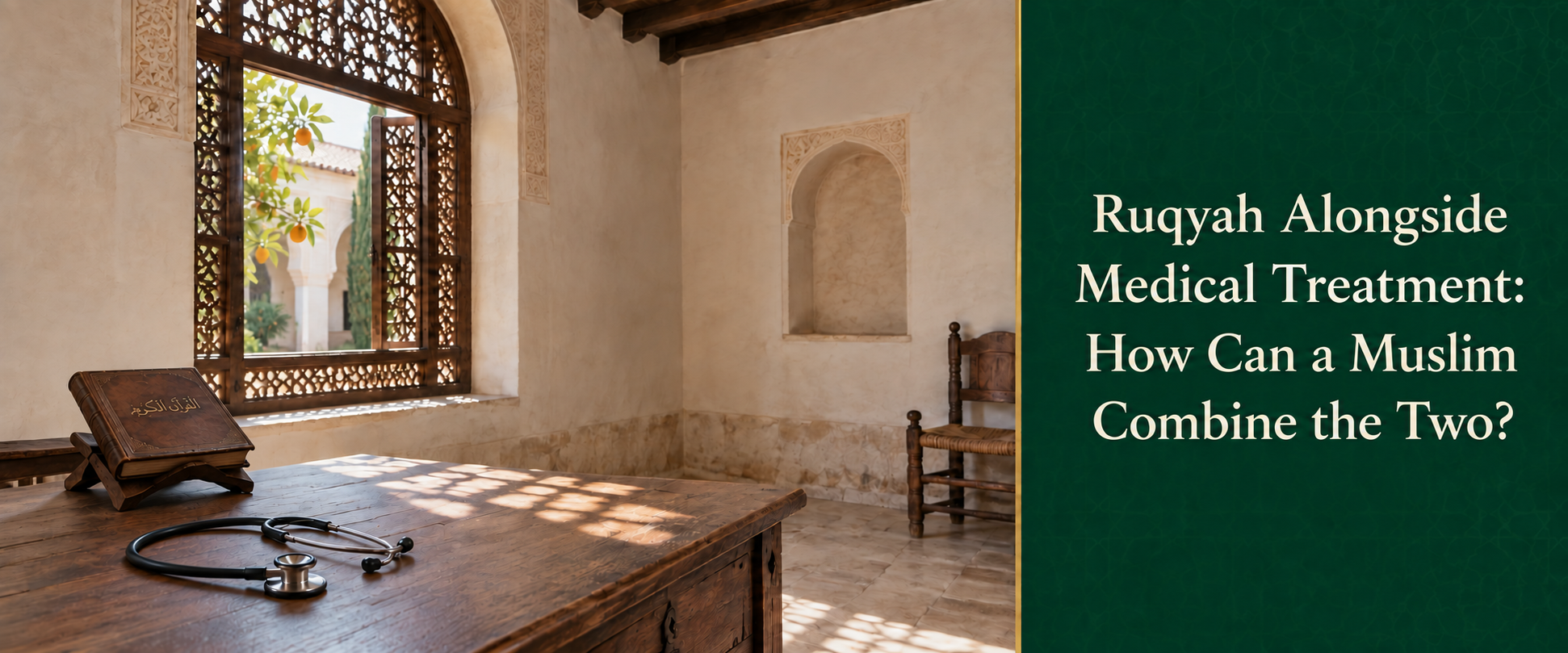
Ruqyah And MeansRuqyah and Medical Treatment: How Can a Muslim Combine Them?
All praise is due to Allah, Lord of the worlds, and may peace and blessings be upon our Prophet Muhammad, and upon his family and companions.
A balanced Muslim understanding is to combine Islamic ruqyah with permissible medical treatment. A Muslim should not make ruqyah a replacement for every form of treatment, and should not treat medicine as an independent cause apart from Allah. Healing is from Allah alone, and the Qur'an, supplication, and medicine are all means that benefit only by His permission.
Allah says about Ibrahim, peace be upon him: "And when I am ill, it is He who cures me." [Ash-Shu'ara': 80]
قال الله تعالى عن إبراهيم عليه السلام: {وَإِذَا مَرِضْتُ فَهُوَ يَشْفِينِ} [الشعراء: 80].
From The SunnahSeeking Treatment Is from the Sunnah
The Prophet صلى الله عليه وسلم said: "Seek treatment, servants of Allah, for Allah has not placed a disease except that He has placed for it a cure." Narrated by Abu Dawud, Al-Tirmidhi, and others; authenticated or graded hasan by a number of scholars.
This shows that seeking treatment does not contradict tawakkul. Rather, it is part of taking the lawful means.
Spiritual MeansRuqyah Is a Lawful Spiritual Means
Ruqyah with the Qur'an and authentic supplications is a lawful means of healing and protection. The Prophet صلى الله عليه وسلم performed ruqyah for himself and others, and he approved his companions' ruqyah with Al-Fatihah.
Physical MeansMedicine Is a Physical Means
Medical treatment is a physical means known through experience and expertise, such as medication, surgery, psychological treatment, nutrition, and rest. There is no conflict between it and ruqyah.
Balanced UnderstandingHow Does a Muslim Combine Them?
- He believes that Allah alone is the true Healer.
- He performs ruqyah upon himself with the Qur'an and authentic supplications.
- He consults a doctor when needed.
- He uses permissible medicine.
- He increases in du'a and istighfar.
- He avoids haram practices and charlatanry.
- He remains patient and does not rush the outcome.
Practical Examples
Example 1When a Muslim Feels Pain in His Body
He says the authentic supplication:
In the name of Allah.
بِسْمِ اللَّهِ
Count: three times
Then he says:
I seek refuge in Allah and His power from the evil of what I feel and fear.
أَعُوذُ بِاللَّهِ وَقُدْرَتِهِ مِنْ شَرِّ مَا أَجِدُ وَأُحَاذِرُ.
Count: seven times
Narrated by Muslim.
Along with this, he should see a doctor if the pain is severe, recurring, or accompanied by serious warning signs.
Example 2When a Person Suffers Worry or Anxiety
He turns to Allah in du'a, maintains the adhkar, and this does not prevent him from seeking advice or permissible treatment when needed.
Common MistakesCommon Mistakes
- Leaving treatment under the claim of tawakkul.
- Relying on the doctor while forgetting du'a.
- Believing that every illness is caused by magic or the evil eye.
- Going to a charlatan when healing is delayed.
- Accusing doctors or people who perform ruqyah without knowledge.
- Neglecting prayer and adhkar, then seeking healing.
ImportantIs Mental Illness Treated with Ruqyah or Medicine?
It is treated with what benefits by Allah's permission: ruqyah, du'a, and adhkar, together with permissible psychological or medical treatment when needed. A Muslim should not shame someone who needs a mental health professional, just as he should not abandon the remembrance of Allah.
FAQDoes going to a doctor contradict tawakkul?
No. It is part of taking lawful means. True tawakkul combines the heart's reliance upon Allah with taking permissible means.
FAQIs ruqyah enough by itself?
Ruqyah may be enough by Allah's permission, and a person may also need another treatment. The matter belongs to Allah, and the means are varied.
FAQCan medicine be used with ruqyah?
Yes. This is the balanced understanding: ruqyah, du'a, and permissible medicine.
FAQWhen should I seek urgent treatment?
When there is severe pain, serious symptoms, recurring illness, psychological distress that affects daily life, or any condition where harm is feared.
ConclusionConclusion
Ruqyah and medical treatment are not opposing paths. Both are means from which a Muslim may benefit by Allah's permission. Let the heart remain attached to Allah, let the Muslim recite the Qur'an and make du'a, and let him take permissible medical means, for all healing is from Allah alone.