
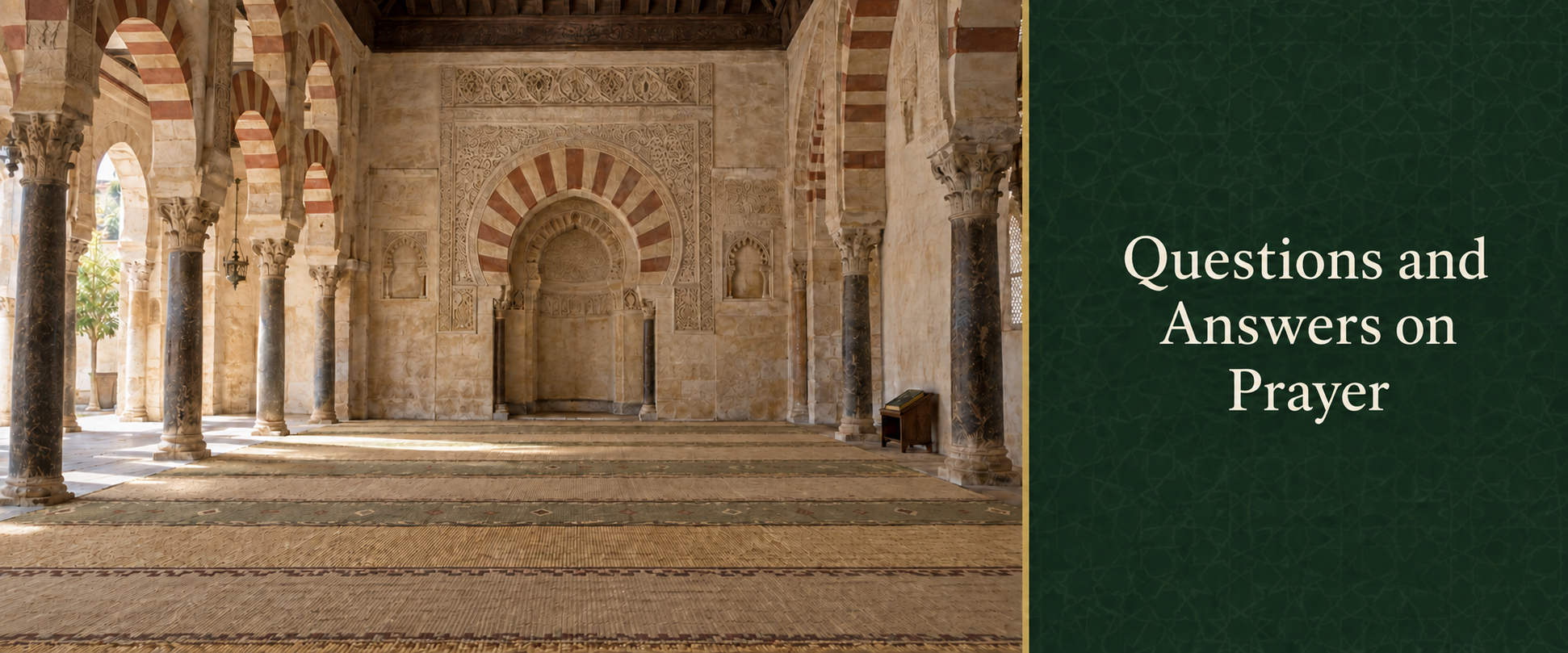
Questions and Answers on Prayer
Prayer is the greatest pillar of Islam after the two testimonies of faith. It is the connection between the servant and his Lord, the first deed a person will be asked about on the Day of Resurrection, and a sign of faith and care for the religion.
Whoever wants rectification for his heart and life should begin by preserving the prayer at its proper time, learning its rulings, and striving for humility and tranquility within it.
What is the status of prayer in Islam?
Prayer is one of the pillars of Islam. It is the pillar of the religion and the greatest practical act of worship.
Establish prayer, give zakah, and bow with those who bow. [Al-Baqarah: 43]
“Islam is built upon five: testifying that there is no deity worthy of worship except Allah and that Muhammad is the Messenger of Allah, establishing prayer, giving zakah, Hajj, and fasting Ramadan.” Agreed upon.
Is prayer obligatory upon every Muslim?
Yes. Prayer is obligatory upon every adult, sane Muslim. It does not fall from a person as long as his mind remains sound, though he prays according to his ability: standing, then sitting if unable, then on his side if unable.
Indeed, prayer has been decreed upon the believers at fixed times. [An-Nisa: 103]
What is the danger of leaving prayer?
Leaving prayer is among the gravest and most dangerous sins. The texts greatly emphasize its status and warn severely against abandoning it.
“The covenant between us and them is prayer; whoever abandons it has disbelieved.” Narrated by Ahmad, At-Tirmidhi, and An-Nasa’i, and authenticated by scholars.
A Muslim must preserve prayer and not be careless about delaying or leaving it.
Is the one who leaves prayer a disbeliever?
This is one of the greatest issues related to prayer. The scholars, past and present, discussed it in detail. There are two well-known views regarding one who leaves prayer out of laziness while still affirming that it is obligatory.
The first view: such a person commits major disbelief if he leaves prayer completely, even if he acknowledges its obligation. Those scholars relied on the apparent meaning of the severe texts about abandoning prayer.
“Between a man and shirk and kufr is abandoning prayer.” Narrated by Muslim. Also: “The covenant between us and them is prayer; whoever abandons it has disbelieved.”
The second view: such a person does not commit major disbelief as long as he affirms its obligation, but he is in tremendous danger. This is the view of the majority of scholars, who regard it as one of the greatest major sins requiring repentance and preservation of prayer.
Whoever denies that prayer is obligatory has committed disbelief by scholarly consensus after the proof is established against him. As for judging specific individuals, this is not for the general public; it belongs to qualified scholars and Islamic judicial authority, with conditions and impediments properly considered.
Scholars mention, in meaning: “It is enough disgrace for the one who abandons prayer that the scholars differed over whether he is Muslim or a disbeliever.” The purpose is to show the seriousness of abandoning prayer, not to open the door to judging individuals.
What are the conditions for a valid prayer?
- Islam.
- Sanity.
- Entry of the prayer time.
- Purification from ritual impurity.
- Removing impurity from the body, clothing, and place.
- Covering the ‘awrah.
- Facing the qiblah when able.
- Intention.
What are the pillars of prayer?
The pillars are matters without which prayer is not valid. If a pillar is left intentionally or forgetfully, it must be performed. Important pillars include standing when able, the opening takbir, reciting Al-Fatihah, bowing, rising from bowing, prostration, sitting between the two prostrations, tranquility, the final tashahhud, sending blessings upon the Prophet صلى الله عليه وسلم in the final tashahhud according to a group of scholars, proper order, and taslim.
“When you stand for prayer, say takbir, then recite what is easy for you from the Qur’an, then bow until you are tranquil in bowing, then rise until you stand upright, then prostrate until you are tranquil in prostration, then rise until you are tranquil sitting, and do that throughout your prayer.” Agreed upon.
What does khushu mean in prayer?
Khushu is the presence of the heart before Allah, stillness of the limbs, honoring the standing before Him, and understanding what one recites and says as much as one is able.
Successful indeed are the believers, those who are humble in their prayer. [Al-Mu’minun: 1-2]
How can a Muslim increase khushu in prayer?
Helpful causes include preparing before prayer, making wudu well, learning the meanings of Al-Fatihah and the adhkar, praying with tranquility, remembering that one is standing before Allah, avoiding turning and fidgeting, and removing what distracts the heart and eyes.
Is congregational prayer obligatory for men?
Congregational prayer is one of the great symbols of Islam. It is obligatory upon able men according to a group of scholars, especially for one who hears the call and has no excuse.
“Whoever hears the call and does not come to it, there is no prayer for him except with an excuse.” Narrated by Ibn Majah and others, and authenticated by a number of scholars.
What should a person do if he misses a prayer?
If someone misses a prayer due to sleep or forgetfulness, he prays it when he remembers.
“Whoever forgets a prayer should pray it when he remembers it; there is no expiation for it except that.” Agreed upon.
As for one who deliberately left prayer, he must sincerely repent, preserve prayer, and ask qualified scholars about his situation and the details of what he missed.
Is it permissible to delay prayer beyond its time?
It is not permissible to delay prayer beyond its time without a valid Islamic excuse.
So woe to those who pray, those who are heedless of their prayer. [Al-Ma‘un: 4-5]
Scholars mention that one of its meanings is those who delay prayer beyond its time and are careless about it.
Is prayer valid without tranquility?
Tranquility is a pillar of prayer, so prayer is not valid without it. The Prophet صلى الله عليه وسلم commanded the man who prayed incorrectly to repeat his prayer because he had not prayed with tranquility.
What invalidates prayer?
Prayer is invalidated by matters including:
- Ritual impurity, such as passing wind, urine, or stool.
- Leaving a condition of prayer when able.
- Intentionally leaving a pillar, such as bowing, prostration, or Al-Fatihah.
- Intentional speech unrelated to the prayer.
- Intentional eating or drinking.
- Many continuous movements without need.
- Audible laughter.
- Exposure of the ‘awrah for a long time when able to cover it.
- Intentionally adding an action-pillar without reason.
- Cutting the intention or deciding to exit prayer.
These issues have details, and rulings may differ with intent, forgetfulness, ignorance, and need. A Muslim should ask scholars about unclear cases.
Does prayer become invalid because of whispers or distraction?
Prayer is not invalidated merely by whispers or wandering thoughts, but its reward decreases according to how absent the heart is. A Muslim should strive for khushu, seek refuge in Allah from Shaytan, and not follow intrusive thoughts.
Does turning during prayer invalidate it?
Turning without need is disliked and decreases the prayer, but slight turning of the face alone does not invalidate it. Turning the whole body away from the qiblah without excuse may invalidate the prayer because it violates the condition of facing the qiblah.
Does speaking during prayer invalidate it?
Intentional speech unrelated to the prayer invalidates it. As for one who speaks forgetfully or out of ignorance, scholars mention further details.
“This prayer is not suitable for any of the speech of people. It is only tasbih, takbir, and recitation of the Qur’an.” Narrated by Muslim.
What should a person do if he adds or omits something forgetfully?
Whoever adds or omits something in prayer forgetfully should follow what came in the Sunnah regarding the prostration of forgetfulness. If he does not know the ruling, he should ask scholars and should not leave prayer out of fear of making mistakes.
The Prophet صلى الله عليه وسلم performed prostration of forgetfulness when forgetfulness occurred from him in prayer, and this is from Allah’s mercy upon this ummah.
Must Al-Fatihah be recited in every rak‘ah?
Reciting Al-Fatihah is a pillar of prayer according to the majority of scholars.
“There is no prayer for one who does not recite the Opening of the Book.” Agreed upon.
The recitation of the follower behind the imam has known details among scholars, especially in audible prayers. The cautious approach is to recite it when possible without competing with the imam.
Is it permissible to pray while sitting?
Whoever is able to stand in an obligatory prayer must stand, because standing is a pillar when able. Whoever cannot stand prays sitting, and if unable, on his side.
“Pray standing; if you cannot, then sitting; and if you cannot, then on your side.” Narrated by Al-Bukhari.
As for voluntary prayer, it is permissible to pray sitting even when able, but the reward of the one who sits without excuse is half that of the one who stands.
Is it permissible to combine prayers?
It is permissible to combine Dhuhr with ‘Asr and Maghrib with ‘Isha while traveling, and for recognized needs such as rain, illness, or severe hardship, according to what scholars have explained. It is not permissible to make combining a habit without an excuse.
Is it permissible to shorten prayer?
Shortening prayer is for travel. The traveler prays Dhuhr, ‘Asr, and ‘Isha as two rak‘ahs. Fajr and Maghrib are not shortened. Shortening prayer is a confirmed Sunnah from the Prophet صلى الله عليه وسلم during travel.
What should a person do if he doubts the number of rak‘ahs?
Whoever doubts the number of rak‘ahs should build upon certainty, which is the lesser number, then perform prostration of forgetfulness, unless one option becomes stronger in his mind, in which case he acts according to what is most likely, with the details found in the Sunnah.
“If one of you doubts in his prayer and does not know how much he has prayed, three or four, let him cast away doubt and build upon what he is certain of, then prostrate twice before giving salams.” Narrated by Muslim.
Is it permissible to pass in front of someone praying?
It is not permissible to pass in front of someone praying if he is praying toward a sutrah or within the place of his prostration, because this has been prohibited.
“If the one passing in front of a praying person knew what was upon him, standing for forty would be better for him than passing in front of him.” Agreed upon.
The one praying should take a sutrah when praying alone or as an imam.
Is it permissible to make du‘a in prostration?
Yes. Making du‘a in prostration is legislated, and it is one of the places where supplication is hoped to be answered.
“The closest a servant is to his Lord is while he is prostrating, so make much supplication.” Narrated by Muslim.