Rituals and Manners

Sunnahs and Manners of Eid

All praise is due to Allah, Lord of the worlds, and may peace and blessings be upon our Prophet Muhammad, and upon his family and companions.

Eid in Islam is a great symbol and a manifestation of lawful joy after worshiping Allah. It is not merely a social custom or a season of amusement. A Muslim rejoices on Eid out of gratitude to Allah and shows takbir, prayer, family ties, and kindness to people while preserving the limits and manners of Islam.

{وَلِتُكْمِلُوا الْعِدَّةَ وَلِتُكَبِّرُوا اللَّهَ عَلَى مَا هَدَاكُمْ وَلَعَلَّكُمْ تَشْكُرُونَ}So that you may complete the number, glorify Allah for what He has guided you to, and perhaps you will be grateful. [Al-Baqarah 2:185]
Lawful Joy

First: Showing Lawful Joy on Eid

Eid is a day of joy, but the Muslim’s joy is disciplined by obedience to Allah, far from forbidden matters, extravagance, and unsuitable imitation.

Allah has replaced them for you with two better days: the Day of Adha and the Day of Fitr.

Narrated by Abu Dawud and An-Nasa'i and authenticated by scholars. This was when the Prophet ﷺ came to Madinah and its people had two days of play.

The two Eids are among the symbols of Islam. Lawful joy, spending on the family, bringing happiness to children, and maintaining ties with relatives are all legislated in them.

Adornment

Second: Bathing and Dressing Well for Eid

It is recommended for a Muslim to bathe for Eid, wear the best permissible clothing he has, and for men to apply perfume when going out to the prayer.

It is established from Ibn Umar رضي الله عنهما that he would bathe on the Day of Fitr before going to the prayer place. Narrated by Malik in Al-Muwatta.

Ibn Umar رضي الله عنهما would also wear his best clothing on Eid, and scholars mention the recommendation of adorning oneself for Eid.

As for a woman going out to the Eid prayer, she should go out modestly, without perfume or tabarruj.

Takbir and Eating Before Prayer
Takbir

Third: Takbir on Eid

Takbir is one of the greatest symbols of Eid. It is an expression of glorifying and thanking Allah.

{وَلِتُكَبِّرُوا اللَّهَ عَلَى مَا هَدَاكُمْ}Glorify Allah for what He has guided you to. [Al-Baqarah 2:185]

For Eid al-Fitr, takbir is legislated from sunset on the last day of Ramadan until the Eid prayer according to a group of scholars.

For Eid al-Adha, takbir is legislated from the beginning of the first ten days of Dhul-Hijjah, and it is emphasized on the Day of Arafah, the Day of Nahr, and the Days of Tashriq. It includes general takbir and restricted takbir after prayers, according to the known details mentioned by scholars.

الله أكبر، الله أكبر، لا إله إلا الله، والله أكبر، الله أكبر، ولله الحمد.Allah is the Greatest, Allah is the Greatest, there is no god but Allah; Allah is the Greatest, Allah is the Greatest, and to Allah belongs all praise.

The matter is broad regarding takbir wordings as long as their meanings are sound and they are established from the Salaf or included in the general meaning of legislated takbir.

Eid al-Fitr

Fourth: Eating Before Eid al-Fitr Prayer

It is from the Sunnah on Eid al-Fitr for a Muslim to eat dates before going out to the prayer.

The Messenger of Allah ﷺ would not go out on the Day of Fitr until he had eaten dates.

In another wording: He would eat them in an odd number. Narrated by Al-Bukhari from Anas ibn Malik رضي الله عنه.

This shows the end of fasting after Ramadan and distinguishes Eid from a day of fasting.

Eid al-Adha

Fifth: Delaying Eating on Eid al-Adha Until Eating from the Sacrifice, If One Offers It

From the guidance of the Prophet ﷺ is that he would not eat on Eid al-Adha until he returned from the prayer and ate from his sacrifice.

The Prophet ﷺ would not go out on the Day of Fitr until he had eaten, and he would not eat on the Day of Adha until he prayed.

Narrated by At-Tirmidhi, Ibn Majah, and Ahmad from Buraydah رضي الله عنه; graded hasan by some scholars.

This applies to the one who offers a sacrifice and can eat from it. It is not obligatory, and whoever needs to eat before the prayer has no blame.

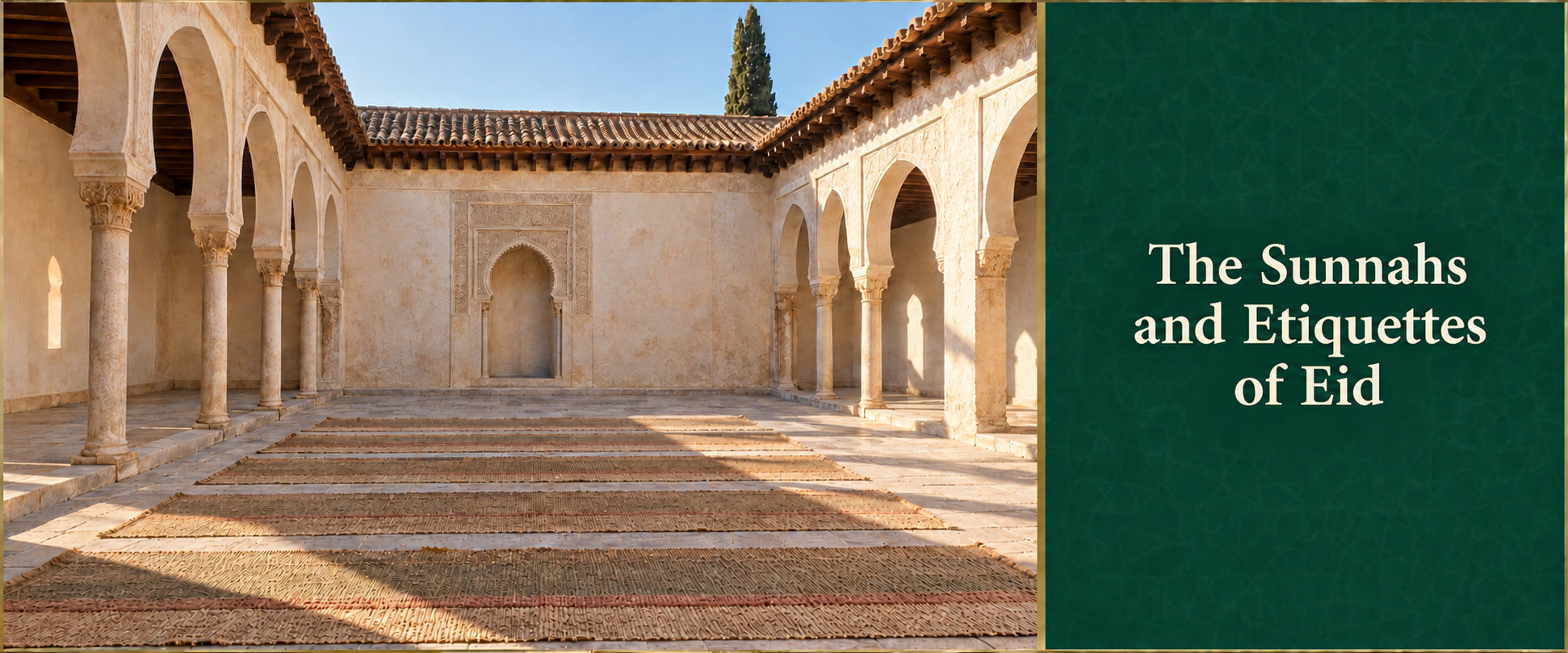
Eid Prayer and Going Out to It
Prayer Place

Sixth: Going Out to the Eid Prayer Place

It was from the guidance of the Prophet ﷺ to pray Eid in the prayer place. It is established in the two Sahihs from Abu Sa'id al-Khudri رضي الله عنه that the Prophet ﷺ would go out on the Day of Fitr and the Day of Adha to the prayer place.

If this is easy, it is from showing the symbol of Eid and gathering the Muslims. If the prayer is held in the masjid because of need, limited space, rain, or valid organization, there is no harm.

Women

Seventh: Women Attending the Eid Prayer with Islamic Guidelines

The Prophet ﷺ legislated for women to attend the Eid prayer.

We were commanded to bring out the young unmarried women and the women who usually remain secluded... and menstruating women should keep away from the prayer place, but witness the good and the supplication of the Muslims.

Agreed upon, from the hadith of Umm Atiyyah رضي الله عنها.

This shows the great importance of Eid prayer. A menstruating woman does not pray, but she witnesses the good and the supplication of the Muslims. A woman’s attendance should be with hijab, modesty, and without perfume, tabarruj, or prohibited mixing.

Different Route

Eighth: Taking a Different Route

It is from the Sunnah to go to the Eid prayer by one route and return by another.

When it was the day of Eid, the Prophet ﷺ would take a different route.

Narrated by Al-Bukhari from Jabir رضي الله عنه.

Scholars mentioned wisdoms for this, including showing the symbol of Eid, greeting the people of both routes, and having the earth testify for him.

Greetings, Family Ties, and Kindness
Greetings

Ninth: Eid Greetings

Congratulating others on Eid is permissible. It is reported from some of the Companions that they would say to one another on Eid: Taqabbal Allahu minna wa minkum, meaning: May Allah accept from us and from you.

Imam Ahmad رحمه الله said: I do not initiate it, but if someone initiates it with me, I respond. This shows that the matter is broad, so one should not object to someone who gives Eid greetings with a good and permissible phrase.

Ties and Kindness

Tenth: Maintaining Family Ties and Showing Kindness to People

Among the manners of Eid are maintaining family ties, honoring parents, bringing happiness to one’s family and children, and showing kindness to the poor and needy, especially on Eid al-Adha by distributing sacrificial meat, and on Eid al-Fitr by giving zakat al-fitr before the prayer.

Eid is not an opportunity for cutting ties or conflict. Rather, it is an opportunity to open the door of reconciliation, forgiveness, and reconnecting what was cut off.

Zakat al-Fitr

Eleventh: Giving Zakat al-Fitr Before the Eid Prayer

One of the most important matters related to Eid al-Fitr is giving zakat al-fitr before the Eid prayer. It purifies the fasting person and feeds the needy.

The Messenger of Allah ﷺ obligated zakat al-fitr: one sa' of dates or one sa' of barley, upon the slave and free person, male and female, young and old among the Muslims, and he commanded that it be given before the people go out to the prayer.

Agreed upon, from the hadith of Ibn Umar رضي الله عنهما.

It should not be delayed until after the Eid prayer without an excuse. Whoever appoints a trusted organization to distribute it should ensure that it reaches its recipients within its Islamic time.

Common Mistakes

Common Mistakes on Eid

  • Leaving takbir and becoming busy only with appearances.
  • Extravagance in clothing and food.
  • Women going out with tabarruj or perfume.
  • Delaying zakat al-fitr until after the Eid prayer without excuse.
  • Fasting the day of Eid.
  • Turning Eid into a season of sins or cutting family ties.
  • Being harsh in broad matters and turning Eid into a source of argument.
FAQ

Is fasting the day of Eid permissible?

No. It is not permissible to fast Eid al-Fitr or Eid al-Adha, because the Prophet ﷺ forbade fasting the Day of Fitr and the Day of Nahr. Agreed upon.

FAQ

Are Eid greetings an established Sunnah?

Eid greetings are reported from some of the Companions with the wording: Taqabbal Allahu minna wa minkum. The matter is broad, and it is a good custom if it is free of anything prohibited.

FAQ

Is bathing for Eid obligatory?

It is not obligatory according to the majority of scholars, but it is recommended and established from some of the Companions. It is part of completing the adornment for this symbol.

FAQ

May women attend the Eid prayer?

Yes. The Prophet ﷺ commanded women to go out for Eid prayer, but with hijab and while avoiding tabarruj, perfume, and Islamic violations.

FAQ

Is zakat al-fitr part of the manners of Eid al-Fitr?

Yes. It is from the symbols at the close of Ramadan, and it is given before the Eid prayer. It should not be delayed beyond that without an excuse.

Conclusion

Conclusion

The sunnahs and manners of Eid preserve the Muslim’s joy within obedience to Allah and help him show the symbols of Islam with dignity and gratitude. Eid is not a break from obedience; it is the completion of worship, the beginning of gratitude, and an opportunity to maintain family ties, revive the Sunnah, and bring happiness to Muslims.

🕋 Eid 1447