Funeral Prayer

The Description of the Funeral Prayer and What Is Said in It

All praise is due to Allah, Lord of the worlds, and may peace and blessings be upon our Prophet Muhammad, and upon his family and companions.

The funeral prayer is one of the rights of a Muslim over his brothers. It is supplication and intercession for the deceased, and a reminder for the living of the Hereafter. The Sunnah has come with an easy and clear description: the worshiper stands, says four takbirs, recites al-Fatihah, then sends prayers upon the Prophet, peace and blessings be upon him, then sincerely supplicates for the deceased, then says salam. It has no bowing, no prostration, no adhan, and no iqamah.

The Prophet, peace and blessings be upon him, said:

"Whoever attends the funeral until the prayer is offered over it will have one qirat, and whoever attends it until it is buried will have two qirats." It was said: What are the two qirats? He said: "Like two great mountains."

Agreed upon.

This is a great virtue that shows the status of praying over a Muslim and following his funeral, and the vastness of Allah's mercy toward His servants.

What Is the Ruling on the Funeral Prayer?
Section

What Is the Ruling on the Funeral Prayer?

The funeral prayer is a communal obligation. If enough Muslims perform it, the sin falls from the rest. If everyone who knew of the deceased and was able to pray it leaves it, they are sinful. It is legislated for men and women, although following the funeral to the cemetery has other rulings.

The greatest purpose of it is that the Muslims intercede for the deceased and supplicate for him sincerely. The Prophet, peace and blessings be upon him, said:

"There is no Muslim man who dies, and forty men who do not associate anything with Allah stand over his funeral, except that Allah accepts their intercession for him."

Narrated by Muslim.

For this reason, the worshiper should bring his heart, intend supplication for the deceased, and not merely perform movements and words without reflecting on them.

Conditions of the Funeral Prayer and Preparing for It
Section

Conditions of the Funeral Prayer and Preparing for It

The funeral prayer is a legislated prayer, so purification from hadath, removal of impurity, covering the awrah, facing the qiblah, and intention are required for it. The intention is in the heart, so pronouncing it is not legislated.

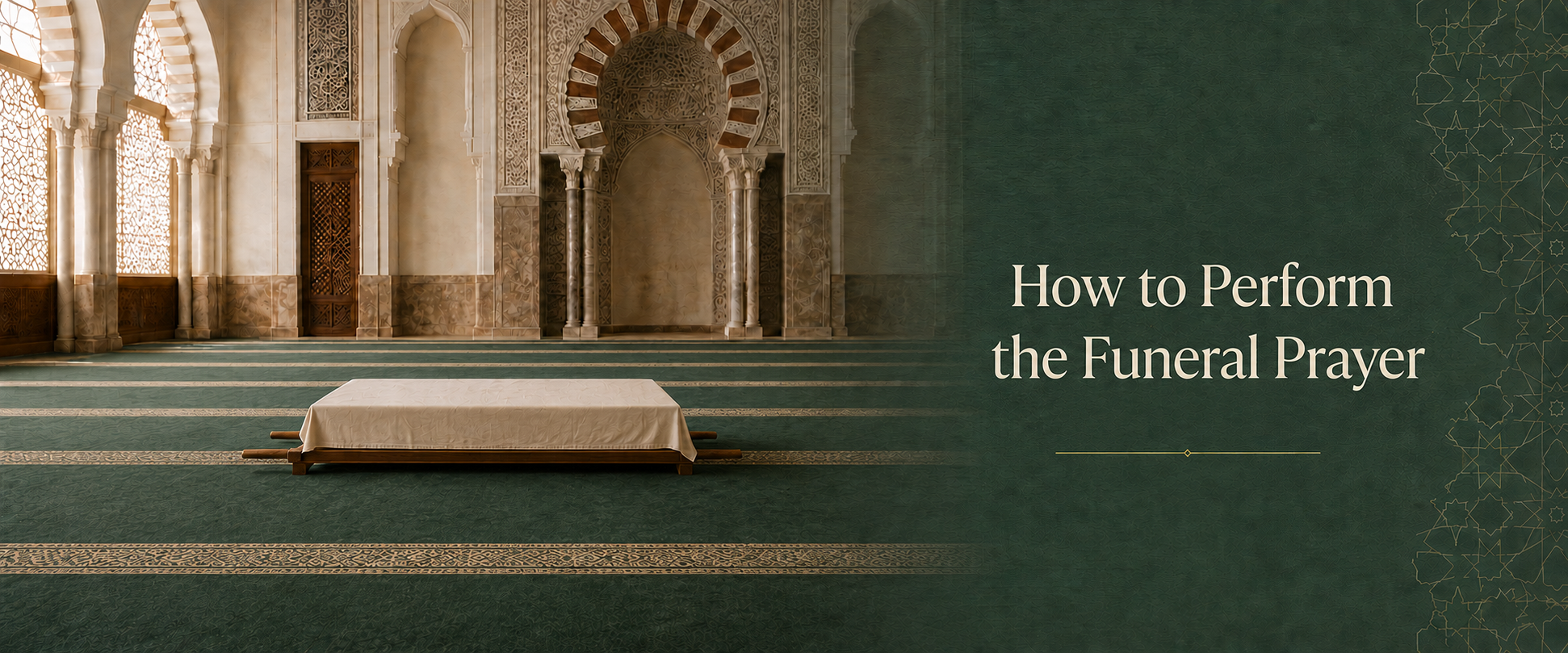
The deceased is placed in front of the imam toward the qiblah, and the worshipers stand behind the imam in rows. Whoever is unable to stand prays according to his ability, because standing is a pillar in it for one who is able.

No adhan or iqamah is legislated for the funeral prayer, and it has no bowing or prostration. Rather, it is all performed standing.

Where Does the Imam Stand for the Funeral of a Man and a Woman?
Section

Where Does the Imam Stand for the Funeral of a Man and a Woman?

The Sunnah is that the imam stands at the head of a man and at the middle of a woman.

Anas ibn Malik, may Allah be pleased with him, prayed over a man and stood at his head, then prayed over a woman and stood at her middle. When he was asked: Is this how the Messenger of Allah, peace and blessings be upon him, used to do? He said: Yes. Narrated by Abu Dawud, al-Tirmidhi, and Ibn Majah, and authenticated by a group of hadith scholars.

This ruling relates to the imam's position. As for the followers, they stand behind him in the rows.

The Funeral Prayer Step by Step
Section

The Funeral Prayer Step by Step

The basis that gathers the order of the funeral prayer is what came from Abu Umamah ibn Sahl, may Allah have mercy on him: that from the Sunnah is that the imam says takbir, then recites al-Fatihah quietly, then sends prayers upon the Prophet, peace and blessings be upon him, sincerely supplicates for the deceased, then says salam. A group of hadith scholars authenticated its chain.

Step One: Intention, Standing, and the First Takbir

The worshiper stands facing the qiblah, intending in his heart to pray over the deceased, then raises his hands to the level of his shoulders or ears and says:

"Allahu akbar."

Then he places his right hand over his left on his chest as he does in the rest of prayer.

He seeks refuge in Allah quietly, says the basmalah, then recites Surah al-Fatihah completely and quietly:

{In the name of Allah, the Most Merciful, the Especially Merciful. All praise is due to Allah, Lord of the worlds. The Most Merciful, the Especially Merciful. Master of the Day of Judgment. You alone we worship, and You alone we ask for help. Guide us to the straight path, the path of those upon whom You have bestowed favor, not of those who earned anger, nor of those who are astray} [al-Fatihah: 1-7].

The evidence is the hadith of Talhah ibn Abdullah ibn Awf, who said:

"I prayed behind Ibn Abbas, may Allah be pleased with them both, over a funeral, and he recited the Opening of the Book. He said: So that they may know that it is Sunnah."

Narrated by al-Bukhari.

The default is to recite quietly. Ibn Abbas, may Allah be pleased with them both, only recited aloud for teaching.

Reciting al-Fatihah is sufficient. A group of scholars recommended reciting a short surah or some verses quietly after it, because it is established from Ibn Abbas, may Allah be pleased with them both, that he recited in the funeral prayer al-Fatihah and a surah, then said: "Sunnah and truth." Narrated by al-Nasai. But reciting a surah is not a pillar or an obligation. Whoever limits himself to al-Fatihah, his prayer is valid. One should not lengthen it, because the funeral prayer is built upon lightness.

Step Two: The Second Takbir and Sending Prayers upon the Prophet, Peace and Blessings Be upon Him

The worshiper raises his hands and says:

"Allahu akbar."

Then he sends prayers upon the Prophet, peace and blessings be upon him, with the Ibrahimic prayer that is said in the tashahhud:

"O Allah, send prayers upon Muhammad and upon the family of Muhammad, as You sent prayers upon Ibrahim and upon the family of Ibrahim. Indeed, You are Praiseworthy, Glorious. O Allah, bless Muhammad and the family of Muhammad, as You blessed Ibrahim and the family of Ibrahim. Indeed, You are Praiseworthy, Glorious."

Step Three: The Third Takbir and Supplication for the Deceased

The worshiper raises his hands and says:

"Allahu akbar."

Then he sincerely supplicates for the deceased. Among the most authentic and comprehensive supplications is what Awf ibn Malik, may Allah be pleased with him, narrated. He said: The Messenger of Allah, peace and blessings be upon him, prayed over a funeral, and I memorized from his supplication:

"O Allah, forgive him and have mercy on him, pardon him and grant him wellbeing, honor his reception, make his entrance spacious, wash him with water, snow, and hail, cleanse him of sins as a white garment is cleansed of dirt, replace his home with a better home, his family with a better family, and his spouse with a better spouse, admit him into Paradise, and protect him from the trial of the grave and the punishment of the Fire."

Narrated by Muslim.

Another established supplication is:

"O Allah, forgive our living and our dead, those present and those absent, our young and our old, our males and our females. O Allah, whoever You keep alive among us, keep him alive upon Islam, and whoever You cause to die among us, cause him to die upon faith."

Narrated by Abu Dawud, al-Tirmidhi, al-Nasai, and Ibn Majah with close wordings, and authenticated by a group of hadith scholars.

It is also permissible to add:

"O Allah, do not deprive us of his reward, and do not lead us astray after him."

If the funeral is for a woman, he says: "O Allah, forgive her and have mercy on her," and changes the pronouns to feminine. If they are a group, he says: "O Allah, forgive them and have mercy on them." The point is not to gather every supplication in one prayer. Rather, he supplicates with what is easy from the transmitted supplications, and gives attention to sincerity and presence of heart.

What Is Said If the Deceased Is a Child?

Supplication is made for the child and for his parents. Among the suitable supplications mentioned by the scholars is:

"O Allah, make him a forerunner and stored reward for his parents, and an accepted intercessor. O Allah, make their rewards great through him, make their scales heavy through him, join him with the righteous predecessors of the believers, place him in the care of Ibrahim, peace be upon him, and protect him by Your mercy from the punishment of Hellfire."

This is a suitable wording mentioned by the scholars, but it should not be attributed in its entirety to the Prophet, peace and blessings be upon him, as a raised hadith. It is permissible to supplicate for his parents with forgiveness, mercy, steadfastness, and reward.

It has come in the hadith:

"The miscarried fetus is prayed over, and supplication is made for his parents for forgiveness and mercy."

Narrated by Abu Dawud and al-Tirmidhi, and authenticated by a group of hadith scholars.

If a child was born alive and then died, the funeral prayer is offered over him. As for a miscarried fetus upon whom no sign of life appeared, if four months had passed, then there is disagreement among the scholars about praying over him. The stronger view, and Allah knows best, is that he is prayed over because the soul has been breathed into him. This is the view of jurists from the people of hadith and the choice of Ibn Baz and Ibn Uthaymin, may Allah have mercy on them. As for what is miscarried before four full months, the funeral prayer is not offered over it because the soul has not been breathed into it. But it is wrapped in a cloth and buried in a suitable place, and patience and seeking reward are legislated for the parents.

Step Four: The Fourth Takbir and Salam

The worshiper raises his hands and says:

"Allahu akbar."

Then he remains silent for a short pause. No specific supplication is established to be regularly observed after the fourth takbir. Then he says salam to his right, saying:

"As-salamu alaykum wa rahmatullah."

One salam is the well-known practice in the funeral prayer according to many scholars. If he says two salams, there is no problem, because the issue is one of recognized scholarly reasoning.

Are the Hands Raised with Every Takbir?
Section

Are the Hands Raised with Every Takbir?

The worshiper raises his hands with the first takbir. It is also legislated to raise them with the remaining takbirs, because that is established from Abdullah ibn Umar and Abdullah ibn Abbas, may Allah be pleased with them, and was chosen by a group of scholars. Then he places the right hand over the left after every takbir.

Whoever raises his hands only in the first takbir, his prayer is valid, because the scholars differed regarding raising the hands with the other takbirs.

How Many Takbirs Are in the Funeral Prayer?
Section

How Many Takbirs Are in the Funeral Prayer?

The usual description upon which the practice of the general body of scholars settled is four takbirs. The Prophet, peace and blessings be upon him, said four takbirs over al-Najashi, and this is established in the two Sahihs. It is also established from Anas, may Allah be pleased with him, that he prayed over a funeral and said four takbirs, and he explained that this is the description of the prayer of the Prophet, peace and blessings be upon him.

Authentic narrations also came with five takbirs, so some scholars said that increasing occasionally is permissible. But the practical Sunnah that should usually be taught and acted upon is four takbirs, and the follower follows his imam and does not oppose him if he increases with an increase that has a basis in the Sunnah.

What Does One Do If He Missed Some Takbirs?
Section

What Does One Do If He Missed Some Takbirs?

He joins the imam in whatever state he finds him and does not wait for the next takbir. He considers what he caught as the beginning of his prayer, then makes up what he missed after the imam says salam.

If he enters while the imam is in the third takbir, he says takbir and recites al-Fatihah, because it is the first takbir in his case. When the imam says the fourth takbir, he says takbir with him and sends prayers upon the Prophet, peace and blessings be upon him. When the imam says salam, he says takbir and supplicates briefly for the deceased, then says the fourth takbir and gives salam.

He shortens the make-up if he fears the funeral will be lifted, bringing the takbirs and required words according to his ability without lengthening.

Is the Funeral Prayer Permissible in the Mosque?
Section

Is the Funeral Prayer Permissible in the Mosque?

Yes, it is permissible in the mosque and in the prayer place designated for funerals. The Prophet, peace and blessings be upon him, prayed over Suhayl ibn Bayda, may Allah be pleased with him, in the mosque as established in Sahih Muslim. There is no problem praying it in any suitable pure place if the conditions are fulfilled.

May a Woman Pray the Funeral Prayer?
Section

May a Woman Pray the Funeral Prayer?

Yes, the funeral prayer is legislated for a woman just as it is legislated for a man. Aishah, may Allah be pleased with her, and women from the wives of the Prophet, peace and blessings be upon him, prayed over Sad ibn Abi Waqqas, may Allah be pleased with him, in the mosque.

It is not correct to prevent a woman from the funeral prayer itself under the claim that it is only for men. As for women going out with the funeral to the cemetery, that is another issue with its own ruling and is not part of the description of the prayer itself.

May the Funeral Prayer Be Prayed After Fajr or After Asr?
Section

May the Funeral Prayer Be Prayed After Fajr or After Asr?

According to a group of scholars, the funeral prayer may be prayed after Fajr and after Asr because it is a prayer with a specific reason, especially when there is need and fear of delaying the funeral.

But the three narrow times in which the Prophet, peace and blessings be upon him, forbade prayer and burial are avoided:

  1. When the sun is rising until it has risen.
  2. When the sun is at its zenith shortly before Dhuhr until it declines.
  3. When the sun begins to set until it has set.

If there is a necessity or fear of harm to the body, the details of the situation should be referred to the people of knowledge.

May the Deceased Be Prayed Over After Burial?
Section

May the Deceased Be Prayed Over After Burial?

Whoever missed praying over the deceased may pray over his grave, because it is established that the Prophet, peace and blessings be upon him, prayed over the grave of a woman who used to clean the mosque after he learned of her death and burial.

Praying over the grave should not be made a repeated habit for someone who already prayed over the deceased before. The scholars differed over the period in which praying over the grave is valid.

What Is the Ruling on the Funeral Prayer in Absentia?
Section

What Is the Ruling on the Funeral Prayer in Absentia?

It is established that the Prophet, peace and blessings be upon him, prayed over al-Najashi, may Allah be pleased with him, on the day he died, and he said four takbirs over him. But the scholars differed: should it be prayed for every absent person, or for one who was not prayed over in the land where he died, or for one who had clear benefit for the Muslims?

Therefore, the funeral prayer in absentia should not be made a habit after every report of death. Rather, one should return regarding it to the people of knowledge and the trusted Islamic authority, and there should be no harsh objection in issues of valid scholarly reasoning if it is established upon a recognized view.

Common Mistakes in the Funeral Prayer
Section

Common Mistakes in the Funeral Prayer

  1. Believing that the funeral prayer does not require wudu, while it is a prayer for which purification is required.
  2. Pronouncing the intention before the takbir, while the intention is in the heart.
  3. Leaving the recitation of al-Fatihah after the first takbir.
  4. Reciting and supplicating aloud without a need for teaching.
  5. Reciting al-Fatihah after every takbir, while the Sunnah is that it is recited after the first only.
  6. Being busy repeating words the worshiper does not understand without sincerely supplicating for the deceased.
  7. Bowing or prostrating in the funeral prayer, while it has no bowing and no prostration.
  8. Opposing the imam in the number of takbirs or saying salam before him.
  9. Leaving prayer over a child or a miscarried fetus into whom the soul was breathed, thinking that he has no sin; the prayer includes supplication for his parents, intercession, and good.
  10. Specifying a supplication that is not established and believing that the prayer is invalid without it.
Frequently Asked Questions
Question

What should I say if I have not memorized the long supplication of the funeral prayer?

It is enough to supplicate for the deceased with what is easy, such as: "O Allah, forgive him and have mercy on him." The more you memorize from the comprehensive prophetic supplications, the better. But the validity of the prayer does not depend on memorizing one specific long wording.

Question

Does the imam recite al-Fatihah and the supplication aloud?

The default is that the recitation, sending prayers upon the Prophet, peace and blessings be upon him, and supplication are done quietly. The imam says the takbir and salam aloud enough for the followers to hear. He may sometimes recite some of it aloud for teaching, as Ibn Abbas, may Allah be pleased with them both, did.

Question

Is there tashahhud in the funeral prayer?

Tashahhud is not recited in the funeral prayer. Rather, al-Fatihah is recited after the first takbir, prayers are sent upon the Prophet, peace and blessings be upon him, after the second, supplication is made for the deceased after the third, then the fourth takbir is said and salam is given.

Question

Is it permissible to supplicate for the deceased with wordings other than those mentioned?

Yes, it is permissible to supplicate for him with any supplication whose meaning is sound, such as asking for forgiveness, mercy, elevation in rank, and salvation from the punishment of the grave and the Fire. But the supplications established from the Prophet, peace and blessings be upon him, are better and more comprehensive.

Question

Is the funeral prayer valid over more than one deceased person at one time?

Yes, it is valid to pray one prayer over several funerals. Men and boys are arranged closest to the imam, and women are placed closer to the qiblah according to the description mentioned by the scholars.

Question

Is prayer offered over a Muslim who died upon a sin or killed himself?

Yes, the Muslims pray over one who died as a Muslim even if he committed a major sin, because sin by itself does not remove him from Islam. Whoever killed himself has committed a grave major sin, but he is not judged to be a disbeliever because of that alone. He is washed, shrouded, and the general Muslims pray over him.

It is established in Sahih Muslim that the Prophet, peace and blessings be upon him, did not personally pray over a man who killed himself. The scholars understood this as a warning against this sin, not as preventing all Muslims from praying over him. The imam or a followed scholar may leave praying over some people of major sins for a clear Islamic interest, while others pray over them. The Muslim deceased should not be left without prayer.

Question

Is prayer offered over a battlefield martyr?

The battlefield martyr who was killed in lawful fighting and died on the battlefield is not washed and the funeral prayer is not offered over him according to the stronger view. The Prophet, peace and blessings be upon him, buried the martyrs of Uhud in their blood and did not pray the usual funeral prayer over them.

As for those whom the Prophet, peace and blessings be upon him, called martyrs because of plague, abdominal illness, drowning, collapse, and similar causes, they are washed and prayed over. They have the reward of martyrdom in the Hereafter, but they do not take the worldly rulings of the battlefield martyr.

Question

Is prayer offered over a non-Muslim?

The funeral prayer is not offered over one who died upon other than Islam, and forgiveness is not sought for him. Allah says:

{And do not ever pray over any of them who has died, nor stand at his grave. Indeed, they disbelieved in Allah and His Messenger and died while they were defiantly disobedient} [al-Tawbah: 84].

As for judging a specific person as Muslim or disbeliever, especially in unclear cases, that is referred to the people of knowledge and the general public should not rush into it.

Question

Is tayammum permissible out of fear of missing the funeral prayer?

Whoever has a valid Islamic excuse that permits tayammum, such as lack of water or inability to use it, makes tayammum and prays. As for mere fear of missing the funeral while water exists and one is able to use it, there is disagreement. The more cautious and stronger position is that he performs wudu, because purification is a condition for prayer, and one does not move to tayammum without a recognized excuse.

Question

Is the funeral prayer repeated for someone who already prayed it once?

What is better according to the majority of scholars is that whoever prayed over the funeral does not repeat the prayer over it again. Some scholars allowed repeating it with another congregation, especially if there is a benefit, so the issue is one of scholarly reasoning. As for one who did not pray over it at all, he may pray over it before burial or over its grave after burial according to the previous detail.

Summary of the Description of the Funeral Prayer
Summary

Summary of the Description of the Funeral Prayer

  1. The worshiper stands with wudu, facing the qiblah, and intends in his heart.
  2. He says the first takbir and recites al-Fatihah quietly.
  3. He says the second takbir and sends prayers upon the Prophet, peace and blessings be upon him, with the Ibrahimic prayer.
  4. He says the third takbir and sincerely supplicates for the deceased with what is established from the supplications.
  5. He says the fourth takbir, remains silent briefly, and does not commit to a specific supplication after it.
  6. He says salam to his right, and the default is one salam.
The funeral prayer is short in its actions but great in its meaning. It is a moment of brotherhood and loyalty, intercession and supplication for a Muslim whose deeds have ended and who is in the greatest need of Allah's mercy. Let the Muslim learn its description, bring his heart into it, and supplicate for his brother with what he would love others to supplicate for him with when he reaches what his brother has reached.