
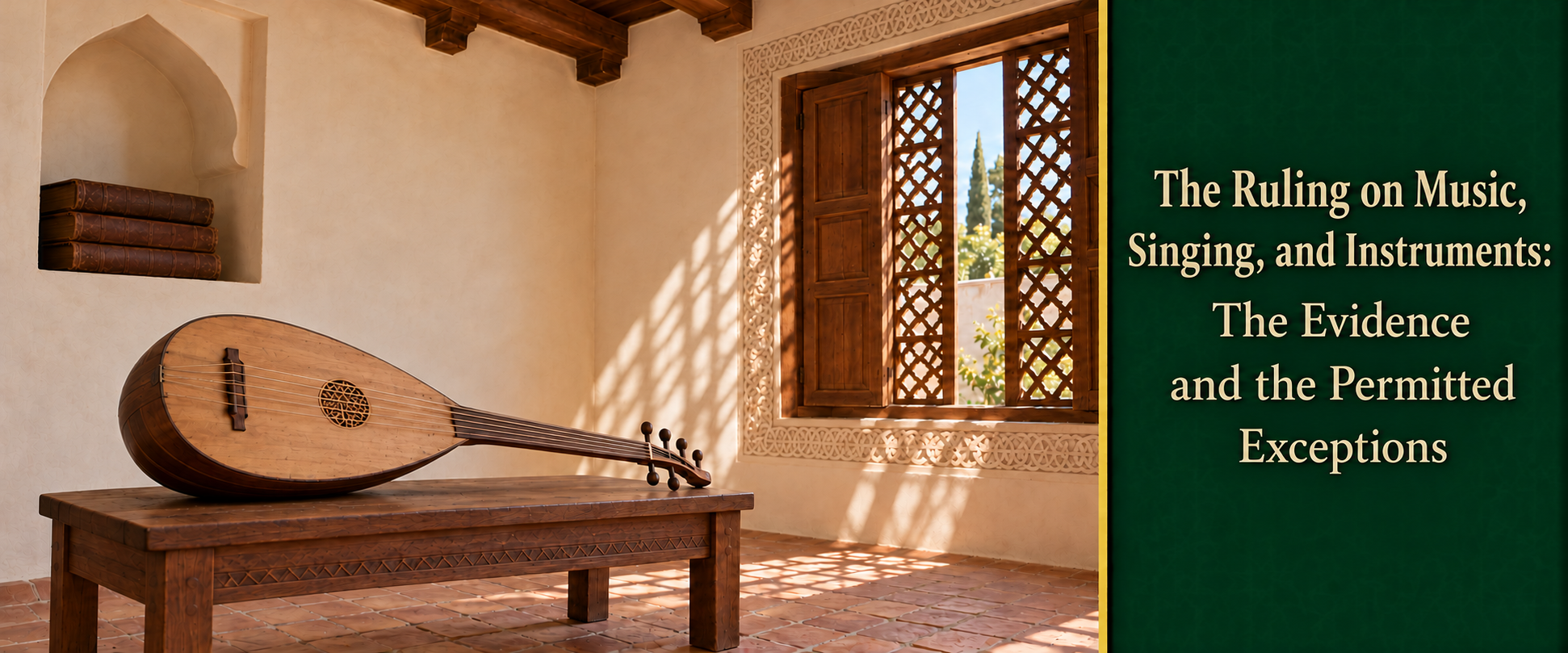
Music and Singing in Islam: Evidence and Exceptions
All praise is due to Allah, Lord of the worlds, and peace and blessings be upon our Prophet Muhammad, his family and companions.
Music appears in short phone clips, advertisements, games and wedding celebrations. The question is therefore not only about a song someone chooses to play. It also concerns sounds heard unintentionally, recordings labelled as nasheeds or sound effects, and the reports permitting singing and the duff on particular occasions.
The basic ruling on musical instruments is prohibition, as explained in the fatwas of Ibn Baz, with exceptions kept within the limits established by the evidence. Unaccompanied voices, poetry and chanting require a different assessment: their words, delivery and circumstances matter. These distinctions allow lawful enjoyment without treating instrumental music as an ordinary means of entertainment.
Musical Instruments and Unaccompanied Singing
Ma'azif refers to instruments used for musical entertainment, such as the oud, violin, flute, piano and guitar, including electronic instruments that perform the same function. The ruling is not restricted to older instruments or a particular genre, and it does not depend on whether the music has lyrics.
Reciting poetry, traditional travel chants and unaccompanied nasheeds is not forbidden merely because the voice is pleasant or melodic. The Prophet, peace and blessings be upon him, said:
«إِنَّ مِنَ الشِّعْرِ حِكْمَةً».
The meaning is that some poetry contains wisdom. Al-Bukhari, 6145. Ibn Baz also permitted wholesome nasheeds free from prohibited elements. Their words must be sound, without obscenity or encouragement of sin; their delivery must avoid temptation, and they must not include prohibited instruments or distract from an obligation. Removing the instruments from a song does not correct objectionable words or an impermissible performance.
Evidence Concerning Instruments and Prohibited Singing
Allah says:
﴿وَمِنَ النَّاسِ مَنْ يَشْتَرِي لَهْوَ الْحَدِيثِ لِيُضِلَّ عَنْ سَبِيلِ اللَّهِ بِغَيْرِ عِلْمٍ وَيَتَّخِذَهَا هُزُوًا أُولَئِكَ لَهُمْ عَذَابٌ مُهِينٌ﴾ [Luqman 31:6].
The verse describes people who acquire distracting talk to lead others away from Allah's path without knowledge and make a mockery of it, warning them of a humiliating punishment.
Ibn Mas'ud, may Allah be pleased with him, explained lahw al-hadith as singing, and Ibn Baz affirmed this attribution. This is a Companion's explanation, not a prophetic hadith. The verse also encompasses other false diversions from Allah's path; "music" is not a word in its Arabic text.
One of the clearest hadiths used as evidence is the Prophet's statement:
«لَيَكُونَنَّ مِنْ أُمَّتِي أَقْوَامٌ يَسْتَحِلُّونَ الْحِرَ وَالْحَرِيرَ وَالْخَمْرَ وَالْمَعَازِفَ».
The passage warns that people from his community will treat illicit intercourse, silk, wine and musical instruments as lawful. Al-Bukhari, 5590, an excerpt. Scholars understand the wording "treat as lawful" as evidence of prohibition. On this understanding, instruments are not prohibited only when a song contains obscene lyrics or when alcohol is also present.
Al-Bukhari introduced the report with the decisive wording, "Hisham ibn 'Ammar said." Hadith scholars identified connected chains elsewhere. Ibn Baz cites Ibn al-Salah and Ibn Hajar's response to the objection: its suspended presentation at this point in al-Bukhari's collection does not, by itself, make the hadith weak.
What Do the Exceptions Permit?
The Duff and Wholesome Wedding Songs
Al-Rubayyi' bint Mu'awwidh, may Allah be pleased with her, reported that young girls beat the duff at her wedding in the Prophet's presence. Al-Bukhari, 5147. Ibn Baz explained that women may use the duff at a wedding with appropriate songs free from obscenity or praise of prohibited conduct, without other musical instruments.
The duff here is a frame covered on one side. Not every drum or percussion instrument becomes a duff by being given that name. Women's wedding singing is kept among women, not broadcast to non-mahram men through loudspeakers or recordings. The wedding permission does not extend to other instruments, unlawful mixing, a performance that causes temptation, missed prayers or disturbance of neighbours.
In the same report, one girl said that a prophet among them knew what would happen tomorrow. The Prophet, peace and blessings be upon him, corrected her:
«دَعِي هَذِهِ، وَقُولِي بِالَّذِي كُنْتِ تَقُولِينَ».
He told her to leave that statement and return to what she had been saying. Permission for the occasion did not make a false statement of belief acceptable. Allah alone has complete knowledge of the unseen, and He discloses what He wills of it to His chosen messengers, as explained in al-Jinn 72:26-27. Words of praise must not attribute comprehensive knowledge of the future to the Prophet or give any created being the attributes that belong exclusively to Allah. Nor may they call upon the Prophet or saints apart from Allah for help that only Allah can give.
Young Girls Singing with the Duff at Eid
Aishah, may Allah be pleased with her, reported that two young girls were singing in her home on Eid about the events of Bu'ath. She explained that they were not professional singers. When Abu Bakr objected, the Prophet, peace and blessings be upon him, said:
«يَا أَبَا بَكْرٍ إِنَّ لِكُلِّ قَوْمٍ عِيدًا، وَهَذَا عِيدُنَا».
He explained that every people has a festival and that this was their Eid. Al-Bukhari, 952. A version in Muslim, 892, mentions the girls playing the duff. This establishes lawful enjoyment at Eid, not unrestricted permission for musical instruments or habitual musical celebrations. See Eid Sunnahs and Etiquettes in Islam for related guidance.
Choosing to Listen and Hearing Unintentionally
Playing music and choosing to follow it is different from a sound reaching you from a shop, neighbour or passing car without your choosing it. Ibn Baz ruled that merely hearing songs without intending or attending to them does not make the listener sinful.
If a musical advertisement appears, mute or skip it when you can, rather than replaying it to enjoy the music. Where you do not control the sound, do not burden yourself with guilt merely because it reaches your ears, while avoiding deliberate listening. Remaining at a celebration involving prohibited acts, or working directly in musical performance, raises further questions and is not simply accidental hearing.
Leaving a Music Habit
Repentance begins with stopping the prohibited listening, regretting what has passed and sincerely resolving not to return. Do not postpone it until you no longer feel drawn to the music. Leaving a familiar habit takes effort; it need not feel easy on the first day.
Delete saved playlists, unfollow accounts that draw you back and turn off autoplay. Before driving, exercising or working, prepare something permissible to listen to, or choose quiet. Every activity does not need a soundtrack. Read and listen to the Quran with attention, and do not let nasheeds displace it or your responsibilities.
If you have shared clips containing music, delete those you can remove or replace them with versions without it. Advise others gently, without insults or damaging their property. For the conditions of returning to Allah, see How to Repent to Allah Sincerely.
Frequently Asked Questions About Music and Singing
Is instrumental music permissible if it has no lyrics or only clean words?
No. Clean lyrics do not change the ruling on the accompaniment, and the absence of lyrics does not remove a piece from the category of instrumental music. This also applies to music described as relaxing or classical.
Can religious nasheeds include musical instruments?
A religious label does not make prohibited instruments permissible. Words of advice or praise do not justify adding them. Quran recitation must also be respected and must not be mixed with music. Beautifying the reciting voice and observing proper recitation are not instrumental performance.
May a man listen to a non-mahram woman's singing if there are no instruments?
Ibn Baz prohibited women singing for non-mahram men. The permission for young girls at Eid, or women singing among themselves at a wedding, must not be extended to an adult woman singing for non-mahram men or broadcasting her singing to them. This does not make a woman's ordinary speaking voice forbidden to hear: normal questions and dealings are different from singing, while seductive speech must also be avoided.
May men play the duff?
Ibn Baz restricted the wedding and Eid permission to women, not men; under his fatwa, men do not play the duff. Jurists have differed over some details of its use, including who may play it, so these details are not all matters of consensus.
May I listen to duff recordings at any time?
Permission for a particular occasion is not permission to make duff recordings an everyday entertainment. Ibn 'Uthaymin prohibited playing a recording of it outside an appropriate occasion in his Open Door Meeting, 229. The label "duff only" is not enough, by itself, to establish that any recording may be played at any time.
Is every sound effect music?
No. Rainfall and birdsong, for example, are not musical instruments. Scholars have prohibited computer-generated sounds or human voices processed to imitate instrumental music: the resulting sound matters, not a label such as "vocal effects." If the nature of a sound is unclear, have it properly identified and ask a qualified scholar about that specific case.
What should I do with educational videos that include music?
Look for a version without it, or mute the audio and use the text and images if the content itself is permissible. If you produce the video, omit the musical background and use speech or permissible effects. Music that unexpectedly appears and is then skipped is different from choosing to keep listening.
May I use a song as my phone ringtone?
Choose an ordinary non-musical alert. A short excerpt does not cease to contain instruments because it serves as a notification. Also avoid letting your phone disturb worshippers or other people.
Am I sinful if music is playing at work or in a shop?
Unintended hearing alone is not sinful, as explained in Ibn Baz's ruling above. Where appropriate, politely ask for the music to be stopped or lowered, and avoid deliberately attending to it. A job that directly involves musical performance or production is a different case: stop the prohibited activity and seek qualified advice about contracts, rights and moving to permissible work.
What if a relative's wedding includes musical instruments?
Speak to the hosts beforehand. Ibn 'Uthaymin explained that accepting an invitation is conditional on there being no prohibited act that the guest cannot remove. He also described attending the part without it and leaving when it begins. Do not remain to enjoy the music merely to please people. Maintain family ties through permissible greetings and visits, without hostility or aggression.
Does an educational purpose allow music in children's nasheeds?
An educational aim does not make prohibited instrumental accompaniment permissible. Choose wholesome words and suitable unaccompanied singing; do not rely on a label such as "for children" or "Islamic." Provide lawful play and activities, and teach gently rather than only saying no. See Raising Children in Islam for broader parenting guidance.
Some scholars permit music. How should I approach that disagreement?
Some scholars have permitted forms of music. The position adopted here, upheld by Ibn Baz and others, is prohibition on the evidence explained above, with the established exceptions. If you are uncertain, consult a scholar trusted for knowledge and adherence to revelation, not simply because his answer is easier or his video more popular.
Does listening to songs take a Muslim outside Islam or cancel every good deed?
Prohibited listening is a sin that diminishes faith; committing it alone does not take a Muslim outside Islam or invalidate all good deeds. This does not minimise the sin. It calls for repentance while continuing prayer and other acts of obedience. Statements of disbelief or mockery of religion are separate matters and must not be confused with merely committing this sin, nor should readers pronounce judgement on particular individuals.
I stopped listening but returned to it. Should I give up repenting?
No. Stop and renew your repentance. Identify what brought you back: an account you still follow, a saved playlist or an unplanned period of spare time. Address that cause instead of treating the lapse as a reason to continue. Seek Allah's help and maintain your obligations and good deeds. Repentance is not reserved for people who have never stumbled before.